








The long-standing honeymoon with the public cloud hyperscalers—AWS, Azure, and Google Cloud—is officially over. In its place, a faster, leaner, and far more flexible movement is taking over: the neocloud era.
If you are a private cloud provider, cloud service provider (CSP), or managed service provider (MSP), this shift represents the single biggest growth opportunity in a decade. But building an alternative cloud infrastructure that actually entices enterprises away from the big three isn't just about spinning up an on-prem MinIO or Cloudian cluster and calling it a day.
It comes down to mastering three non-negotiable pillars: data sovereignty, speed, and scalability.
And more importantly, it requires the underlying traffic management glue that holds those pillars together. Here’s how next-gen cloud providers are pulling it off.
Why enterprises have fallen in love with neocloud
Hyperscaler fatigue is real. Instead of dumping every workload into a monolithic public cloud, forward-thinking organizations are taking a step back and choosing a smarter, more modular approach.
They’re building highly specialized infrastructure around independent cloud providers and S3-compatible object storage (think MinIO, Ceph, Wasabi, and Cloudian). It’s leaner, faster, more predictable, and puts control firmly back where it belongs: in the hands of the business.
- Zero lock-in: Their applications talk standard S3. If a vendor changes their terms, you can point your API calls elsewhere without rewriting your application logic.
- Geographic governance: They can decide the exact physical data center where their data lives, keeping local regulators happy and compliance audits smooth.
- Cost predictability: They can say goodbye to eye-watering egress fees designed to keep their data hostage.
Freedom and lower bills sound amazing on paper, but it raises a crucial operational question: How do neocloud providers guarantee the enterprise-grade uptime, speed, and resilience users expect when stepping away from the hyperscaler safety net?
S3-compatible object storage: The neocloud bedrock
There used to be a widespread myth that object storage was only good for cold archiving—the digital equivalent of a dusty filing cabinet in the basement.
That myth is officially dead.
Modern S3-compatible storage systems are blazing fast. Today’s neocloud storage architectures handle active analytics pipelines, media streaming, massive AI/ML training datasets, and high-frequency backups. But with high throughput comes high responsibility.
When you scale S3 storage nodes horizontally to handle petabytes of data, you create a broad interface for incoming traffic. If thousands of application clients attempt to query a single node simultaneously, speed vanishes, latency spikes, and your service stutters.
To maintain low latency and enterprise-grade speed at scale, you need a smart traffic distribution mechanism that evenly balances GET and PUT requests across your entire storage topology.
The unsung hero: Why load balancing underpins it all
You can buy the fastest NVMe drives on the market, build a state-of-the-art regional storage pool, and configure the sleekest S3 software cluster available. But if applications can't reliably reach that storage—or if a single node failure takes down an entire bucket—your neocloud strategy stalls out.
This is where dedicated, storage-aware load balancing steps into the spotlight.
The golden rule of neocloud resilience is storage software manages your data; load balancers manage access to your data. Neither can deliver true high availability without the other.
Here's how intelligent load balancing quietly powers the neocloud storage layer under the hood:
- High Availability and instant failover: Nodes fail, drives crash, and maintenance happens. A dedicated load balancer continuously monitors the health of your S3 storage nodes at both Layer 4 and Layer 7. If a storage node stops responding correctly to S3 API calls, traffic is re-routed to healthy nodes in milliseconds. Your end users never notice a hiccup.
- Maximizing throughput and eliminating bottlenecks: Heavy multi-part uploads and large concurrent S3 requests can choke network interfaces if sent to the wrong node. Smart load balancing algorithms distribute traffic based on actual server load, connection density, and node capacity—ensuring every bit of throughput you paid for is utilized efficiently.
- Offloading heavy SSL/TLS processing: Encrypting and decrypting SSL traffic takes a massive toll on server CPU cycles. By terminating SSL encryption at the load balancer layer, you free up precious compute resources on your storage nodes so they can focus on what they do best: reading and writing data fast.
Neocloud case study: Scaling sovereign S3 to 200+ petabytes
"When you're building a sovereign cloud for highly regulated and government-level organizations, 'good enough' doesn't cut it. We needed extreme speed, bulletproof security, and absolute resilience from day one."
The challenge: Building a sovereign cloud that couldn’t fail
A leading private cloud provider set out to redefine private cloud infrastructure by delivering a fully sovereign, ultra-secure platform tailored for sensitive governmental bodies. They needed to support thousands of concurrent users accessing massive datasets with zero millisecond lag—all while adhering to the strictest data sovereignty standards.
They chose Scality as their object storage core, but managing unstructured data at exascale required an integrated end-to-end ecosystem with validated hardware and traffic management partners.
The solution: Scality + HPE + Loadbalancer.org
To deliver a complete, precision-engineered storage stack, Scality brought together HPE and Loadbalancer.org:
- HPE supplied resilient compute and storage hardware.
- Scality deployed their RING object storage software to manage hundreds of petabytes seamlessly.
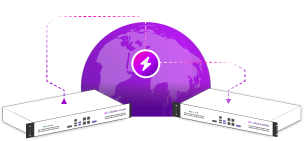
- Loadbalancer.org deployed hundreds of high-performance load balancers across segregated storage clusters, delivering application delivery and Global Server Load Balancing (GSLB) across multiple data centers:
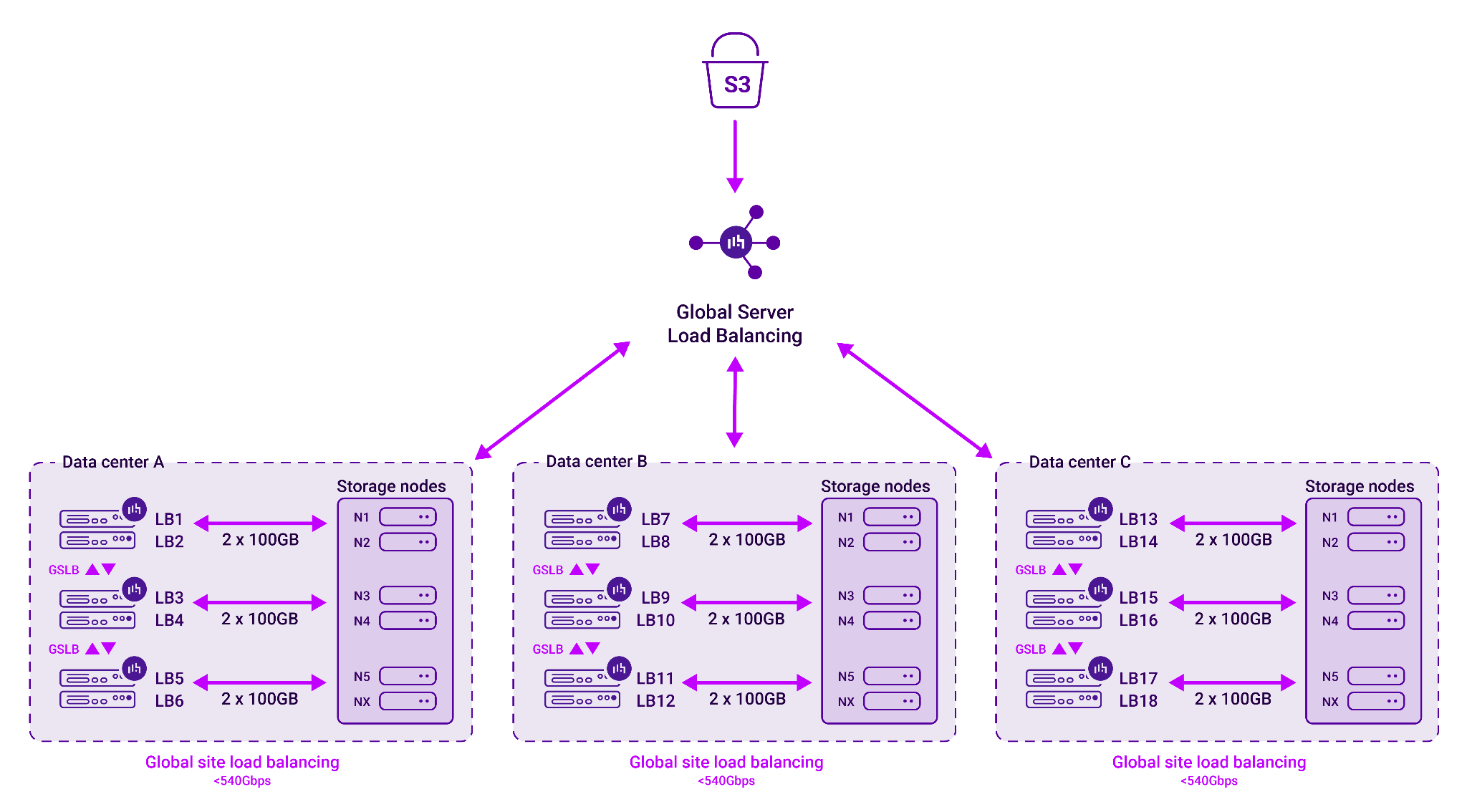
The results: Exascale-ready, unbreakable, and fully autonomous
By uniting Scality and Loadbalancer.org under one hood, this sovereign cloud provider was able to transform their private cloud vision into an operational reality. Here is what they achieved:
- Ironclad security and sovereignty: Independent, segregated private cloud clusters guarantee completely uncompromised operations and strict compliance—even during localized incidents.
- Lightning-fast throughput at massive scale: With over 200 Petabytes of storage capacity, our platform effortlessly handles thousands of concurrent users without bandwidth bottlenecks.
- Exascale AI-readiness: Our infrastructure is fully optimized for heavy AI/ML workloads and real-time analytics, giving our clients a future-proof data platform.
- Multi-site resilience: Coordinated integration and GSLB mean zero downtime, seamless traffic distribution, and frictionless future expansions.
- Total operational empowerment: Rather than relying permanently on external vendor engineers, Loadbalancer.org and the partner ecosystem empowered their internal team with the tools and training to manage the environment autonomously.
Ready to build unshakeable neocloud architecture?
The shift away from hyperscalers isn’t a distant trend—it’s happening right now. Enterprises want sovereign, cost-effective, high-performance S3 storage, and neocloud providers are in the prime position to win those workloads.
To beat the hyperscalers at their own game, your infrastructure can’t just be competitively priced—it has to be bulletproof.
Storage software manages your data, but dedicated load balancing manages access to that data. Pairing robust S3 storage engines with storage-aware traffic management is how you deliver true enterprise resilience, extreme throughput, and multi-site uptime.
Let’s build something great together
At Loadbalancer.org, we don't just build load balancers—we specialize in storage architecture. We understand S3 traffic bottlenecks, SSL offloading demands, and the unique challenges cloud service providers face every day.
Whether you're scaling an existing S3 cluster, building out a sovereign cloud, or looking for a partner that offers flexible, service-provider-friendly licensing:
- 🛠️ Explore our S3 storage load balancing solutions
- 💬 Talk to one of our storage traffic experts about your architecture
- 📘 Download our storage deployment guides to see the full blueprint in action
Let’s keep your data moving fast, your nodes healthy, and your customers thrilled.
Audit your storage stack for performance bottlenecks.



Demystifying GSLB in Cisco ACI: How to fix failover quirks and avoid the iQuery headache

Related posts
Envoy proxy vs. purpose-built load balancing for object storage

Multi-site HPE Alletra Storage MP X10000 with Global Server Load Balancing

How to load balance a MariaDB Galera Cluster for performance and HA using LVS & Ldirectord

How to use content-length headers to solve the 'small objects problem'
High zero-day in Citrix NetScaler ADC & Gateway: Patch CVE-2026-88779

Critical zero-day in F5 BIG-IP APM: Emergency CVE-2026-94127 hotfixes released
Critical zero-days in Citrix NetScaler ADC & Gateway: Patch CVE-2026-88771 and CVE-2026-88772 immediately
The ultimate VMware NSX alternative: Nutanix + Loadbalancer.org