





Critical flaws in F5 BIG-IP: Emergency hotfixes released for 6 RCE vulnerabilities
Following September's active exploitation of CVE-2026-94127, organizations must treat patching as an immediate operational priority.

F5 published its out-of-band security notification (K000164058) and emergency engineering hotfixes on 18 November 2026, alongside fixes for six high-severity vulnerabilities—including a critical-impact SAML denial-of-service flaw (CVE-2026-126822, CVSS v4.0: 8.7 / CVSS v3.1: 7.5) that requires the same emergency hotfix path.
As of 20 November, no active exploitation in the wild has been publicly confirmed. However, following September's active exploitation of CVE-2026-94127—and with Shadowserver identifying more than 177,000 internet-facing BIG-IP instances and over 14,600 IP addresses exposing BIG-IP APM fingerprints—organizations must treat patching as an immediate operational priority.
What are the November 2026 BIG-IP vulnerabilities?
All seven flaws covered in this emergency engineering hotfix batch are memory-corruption vulnerabilities affecting the Traffic Management Microkernel (TMM), the core component responsible for processing live connections through BIG-IP. For the six critical stack-based buffer overflows (CWE-121), a remote, unauthenticated attacker can send crafted traffic to a vulnerable virtual server to terminate TMM—interrupting active user sessions during restart—or execute arbitrary code on the underlying appliance. The seventh flaw (CVE-2026-126822) is an integer underflow (CWE-191) that triggers a TMM restart and denial of service.
17.1.3.6, 17.5.1.10, and 21.1.0.3.Critical threat attributes:
- No authentication required: Attackers do not need valid user credentials or session tokens to reach the vulnerable code paths.
- Data plane exposure: Traffic hits TMM directly through standard application virtual servers. Restricting access to the BIG-IP management interface (control plane) will not mitigate these threats.
- No workarounds for the RCE flaws: F5 published zero configuration workarounds for the six critical RCE vulnerabilities; installing the appropriate engineering hotfix is the only remediation.
- Outage risk to critical services: As highlighted in a Health-ISAC bulletin published by the American Hospital Association, even a transient TMM restart can drop access to electronic health record (EHR) portals, telehealth platforms, and clinical remote access while back-end databases remain healthy.
Breakdown of the 7 CVEs
Five of the critical flaws are stack-based buffer overflows in programmable iRules, while the sixth critical flaw and the high-severity SAML integer underflow affect Access Policy Manager (APM):
| CVE | Advisory | Severity (v4.0 / v3.1) | Root Cause & Affected Component |
|---|---|---|---|
| CVE-2026-121805 | K000163946 | 9.3 / 9.8 | Stack-based buffer overflow in iRules using PEM::subscriber (BIG-IP PEM, CNF, Next for Kubernetes) |
| CVE-2026-120292 | K000163940 | 9.3 / 9.8 | Stack-based buffer overflow in iRules using MR::message route with an HTTP profile (BIG-IP, Next for Kubernetes) |
| CVE-2026-120285 | K000163939 | 9.3 / 9.8 | Stack-based buffer overflow in iRules using PSC::ip_address with an HTTP profile (BIG-IP, CNF, Next for Kubernetes) |
| CVE-2026-116953 | K000163941 | 9.3 / 9.8 | Stack-based buffer overflow in iRules using GENERICMESSAGE::route (BIG-IP, Next for Kubernetes) |
| CVE-2026-120722 | K000163945 | 9.3 / 9.8 | Stack-based buffer overflow in iRules using DNS::scrape (BIG-IP DNS, CNF, Next for Kubernetes)* |
| CVE-2026-123637 | K000163937 | 9.3 / 9.8 | Stack-based buffer overflow in BIG-IP APM per-request policies combining Client Information and Endpoint Security agents |
| CVE-2026-126822 | K000163942 | 8.7 / 7.5 | Integer underflow (CWE-191) in BIG-IP APM configured as a SAML Service Provider (SP) |
Are you affected? Identifying exposed configurations
Not every BIG-IP deployment is vulnerable. Exposure depends entirely on the specific profiles and iRules attached to reachable virtual servers—including DNS and cloud-native deployments (BIG-IP DNS, BIG-IP CNF, and BIG-IP Next for Kubernetes), which could otherwise be missed in a web-only audit.
- VULNERABLE = Virtual servers exposing traffic to TMM with any of the affected iRules (subscriber info, generic message routing, HTTP + message routing/IP-address functions, or DNS traffic), an APM per-request policy combining Client Information and Endpoint Security agents, or an APM SAML Service Provider access profile.
- NOT VULNERABLE = Virtual servers and appliances that do not have the affected iRules, APM agents, or SAML SP profiles attached to active listeners.
Affected F5 BIG-IP products and immediate actions
F5 has released build-specific emergency engineering hotfixes for active release branches (detailed in F5 advisory K000164239). As NHS England noted in its cyber alert, F5 only evaluates versions still within technical support—software past its End of Technical Support (EoTS) date should be assumed vulnerable and accounted for separately.
CNF-2.2.5-EHF1, CNF-2.3.4-EHF1, CNF-2.4.2-EHF1 and BNK-2.2.5-EHF1, BNK-2.3.4-EHF1, BNK-2.4.2-EHF1).Required engineering hotfix paths (BIG-IP TMOS)
| BIG-IP Branch | Current Installed Release or EHF Build | Target Emergency Hotfix Build |
|---|---|---|
| 17.1.x | 17.1.3.7 or earlier base release in branch |
BIGIP-17.1.3.7.0.21.4-ENG |
| 17.1.x (Prior EHF) | BIGIP-17.1.3.6.0.9.20-ENG |
Hotfix-BIGIP-17.1.3.6.0.14.20-ENG |
| 17.5.x | 17.5.1.11 or earlier base release in branch |
BIGIP-17.5.1.11.0.61.12-ENG |
| 17.5.x (Prior EHF) | BIGIP-17.5.1.10.0.7.35-ENG or BIG-IP-17.5.1.10.0.37.35-ENG |
Hotfix-BIGIP-17.5.1.10.0.80.35-ENG |
| 21.1.x | 21.1.0.4 or earlier base release in branch |
BIGIP-21.1.0.4.0.19.3-ENG |
Step-by-step remediation
1. Log into the ADC Portal
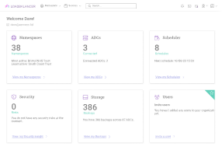
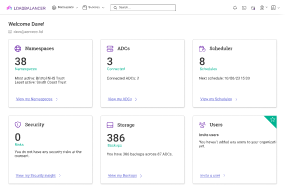
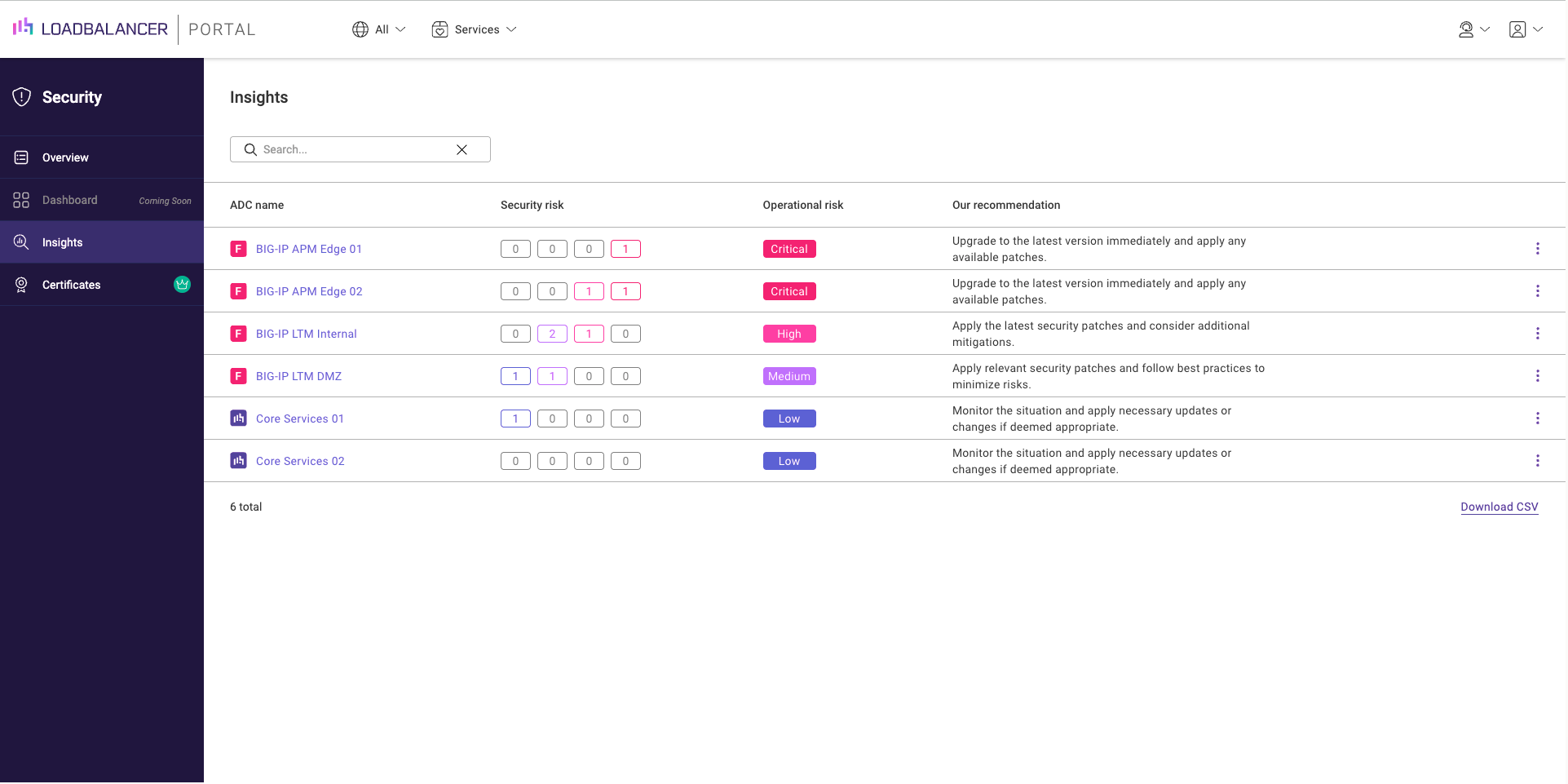
The Loadbalancer.org ADC Portal automatically scans for Common Vulnerabilities and Exposures (CVEs) affecting connected Application Delivery Controllers (ADCs) by querying the NIST National Vulnerability Database.
Once logged in to your ADC Portal account, navigate to Security > Insights to identify your affected F5 appliances and verify their exact running TMOS build versions.
2. Preserve logs and state evidence
Because updating software can overwrite volatile forensic traces, check for signs of potential compromise first if you manage internet-facing instances. Take snapshot logs and evaluate system activity before applying the patch.
3. Stage and install the matching Engineering Hotfix ISO
Because F5 distributes Engineering Hotfixes (EHFs) as custom ISO images via MyF5 rather than standard GA point-release feeds, download the exact build-matched EHF ISO from MyF5 Downloads (referencing K000164239). Upload the ISO image to each affected appliance, install it onto an inactive boot volume (e.g., HD1.2), and reboot into the patched volume during a maintenance window.
4. Contact our support team for a free load balancer health check
The ADC Portal can help you identify, mitigate, and resolve Common Vulnerabilities and Exposures (CVEs) across your F5, NetScaler, Progress Kemp and Loadbalancer.org fleet. To find out how, contact our support team.
5. Verify end-to-end service transactions
Once patched, confirm that dependent application flows—from DNS resolution to SAML federated sign-ins and clinical portal authentication—complete without interruption.
Further reading
- F5 out-of-band security notification (November 18, 2026): K000164058
- Special considerations for engineering hotfixes: K000164239
- K000163946: CVE-2026-121805 (
PEM::subscriberiRule) - K000163940: CVE-2026-120292 (
MR::message routeiRule) - K000163939: CVE-2026-120285 (
PSC::ip_addressiRule) - K000163941: CVE-2026-116953 (
GENERICMESSAGE::routeiRule) - K000163945: CVE-2026-120722 (
DNS::scrapeiRule) - K000163937: CVE-2026-123637 (APM Client Information + Endpoint Security)
- K000163942: CVE-2026-126822 (APM SAML Service Provider DoS)
Improve your F5 security posture with the ADC Portal.

High zero-day in Citrix NetScaler ADC & Gateway: Patch CVE-2026-88779

Related posts
High zero-day in Citrix NetScaler ADC & Gateway: Patch CVE-2026-88779
Critical zero-day in F5 BIG-IP APM: Emergency CVE-2026-94127 hotfixes released
Critical zero-days in Citrix NetScaler ADC & Gateway: Patch CVE-2026-88771 and CVE-2026-88772 immediately
HAProxy Enterprise Edition vs Progress Kemp LoadMaster: A no-fluff engineer comparison

The ultimate VMware NSX alternative: Nutanix + Loadbalancer.org

Demystifying GSLB in Cisco ACI: How to fix failover quirks and avoid the iQuery headache

Building resilient neocloud S3 storage architecture: The critical role of load balancing
How can I load balance UDP with open source HAProxy?