







Load balancing Philips Healthcare Information Systems (HCIS)
Updated on September 8, 2026
•
Published on March 6, 2023
Benefits of load balancing Philips HCIS
Load balancing Philips Healthcare Information Systems (HCIS) is critical for ensuring the continuity of patient care by delivering enterprise imaging solutions that are unbreakable, fast, and scalable.
- High Availability (HA): Load balancing ensures that HCIS applications, such as Philips PACS (Picture Archiving and Communication System) and RIS (Radiology Information System), are always available. By distributing traffic across multiple servers and performing continuous health checks, the load balancer automatically reroutes requests away from any server that fails, is offline, or is undergoing maintenance. This failover capability minimizes downtime and ensures clinicians have uninterrupted access to critical patient data and images, which is vital in a healthcare setting.
- Optimum performance: Load balancing prevents any single HCIS server from becoming overwhelmed by traffic. By evenly distributing the workload, it eliminates bottlenecks, reduces server strain, and leads to faster response times for image retrieval and data access. This ensures stable and optimal performance, even during periods of peak demand, allowing doctors to make more confident clinical decisions quickly.
- Scalability: It allows the HCIS infrastructure to easily adapt to increasing demands and growing data volumes (e.g., more imaging studies or users). You can add new physical or virtual servers to the HCIS server pool as needed, and the load balancer automatically incorporates them into the traffic distribution. This ensures that the system can scale seamlessly without compromising performance or stability.
About Philips HCIS
Philips HCIS is an image storage and distribution system that provides fast and user-friendly access to images from multiple modalities, consisting of two key applications:
- Philips RIS/WIM
- Philips Vue PACS
For caregivers to work effectively, peak performance of Philips HCIS applications is critical. Philips HCIS supports clustering, scaling to millions of studies per year and hundreds of concurrent users, and doctors demand instant image and data retrieval, zero downtime, and systems which are easy to maintain with simple security updates.
Clustering multiple load balanced Philips HCIS servers provides product managers with a fast, cost-effective, highly available and scalable solution, in an environment where study volume is ever increasing.
Why Loadbalancer.org for Philips applications?
Loadbalancer.org provides robust application delivery for Philips mission critical medical imaging applications, ensuring crucial healthcare systems remain continuously accessible to providers.
Built on a long-standing technical alliance, this strategic partnership simplifies the delivery of precision care, allowing clinicians to focus on patient care, not reporting slow or broken systems.
By integrating Loadbalancer.org’s intuitive technology, Philips equips its customers with more user-friendly solutions that streamline daily operations and support faster, more cost-effective deployments.
Load balancing Philips HCIS
A typical Philips HCIS deployment uses our ultra-fast Layer 4 Direct Routing DR Mode – sometimes referred to as Direct Server Return (DSR) – to combine fast, highly available storage with unrestricted image retrieval. This high-performance solution requires little change to your existing infrastructure.
A Philips HCIS server deployment can also be load balanced with Layer 7 Reverse Proxy, which might be preferable if real servers cannot be changed. With Layer 7, you get to implement smarter load-balancing decisions giving you greater flexibility.
Having partnered with top-tier healthcare vendors, Loadbalancer.org brings expert consultancy and support to all of our deployments. Our extensive experience in Enterprise Imaging means that we understand the challenges you face, and are ready to meet them with tried-and-tested solutions.
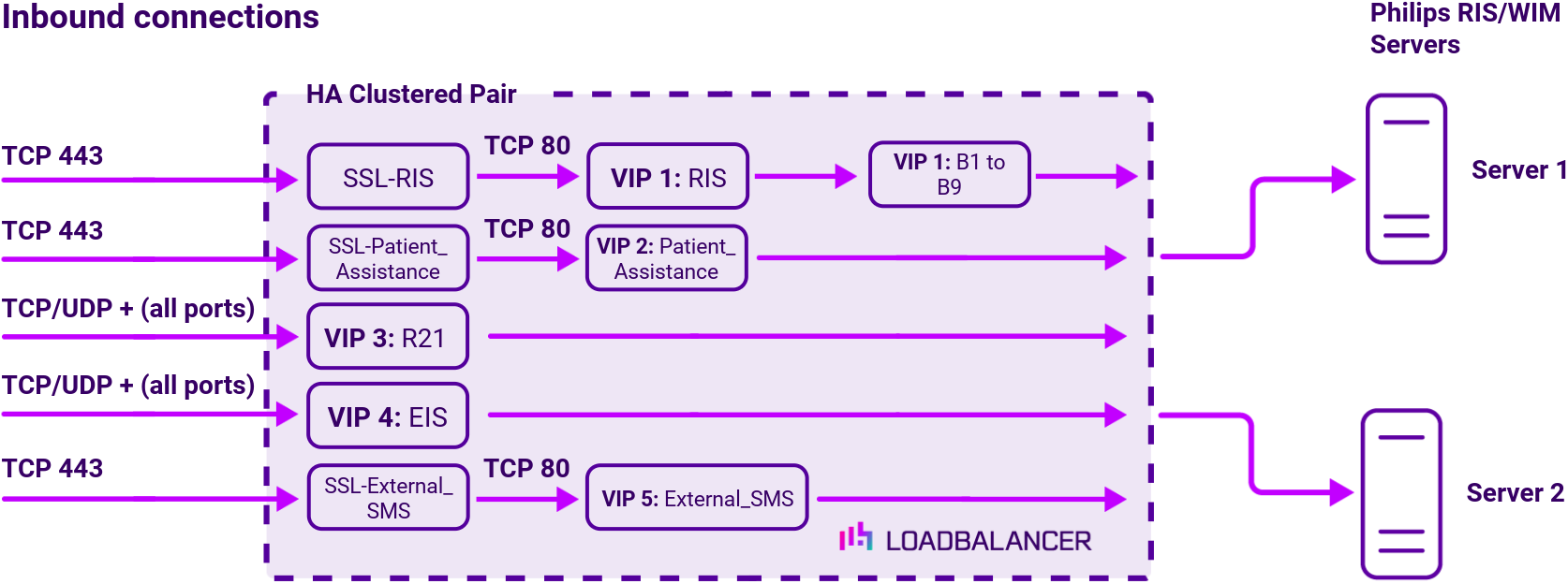
How to load balance Philips RIS/WIM
Philips’ Radiology Information System (RIS) and Workflow Information Management (WIM) application forms part of the Philips HCIS suite.
For full details of how to load balance this solution:
- Summary – A summary of the recommended deployment for RIS/WIM.
- Deployment guide – The full Philips RIS/WIM load balancer deployment guide.
Here’s a summary of the deployment concept:
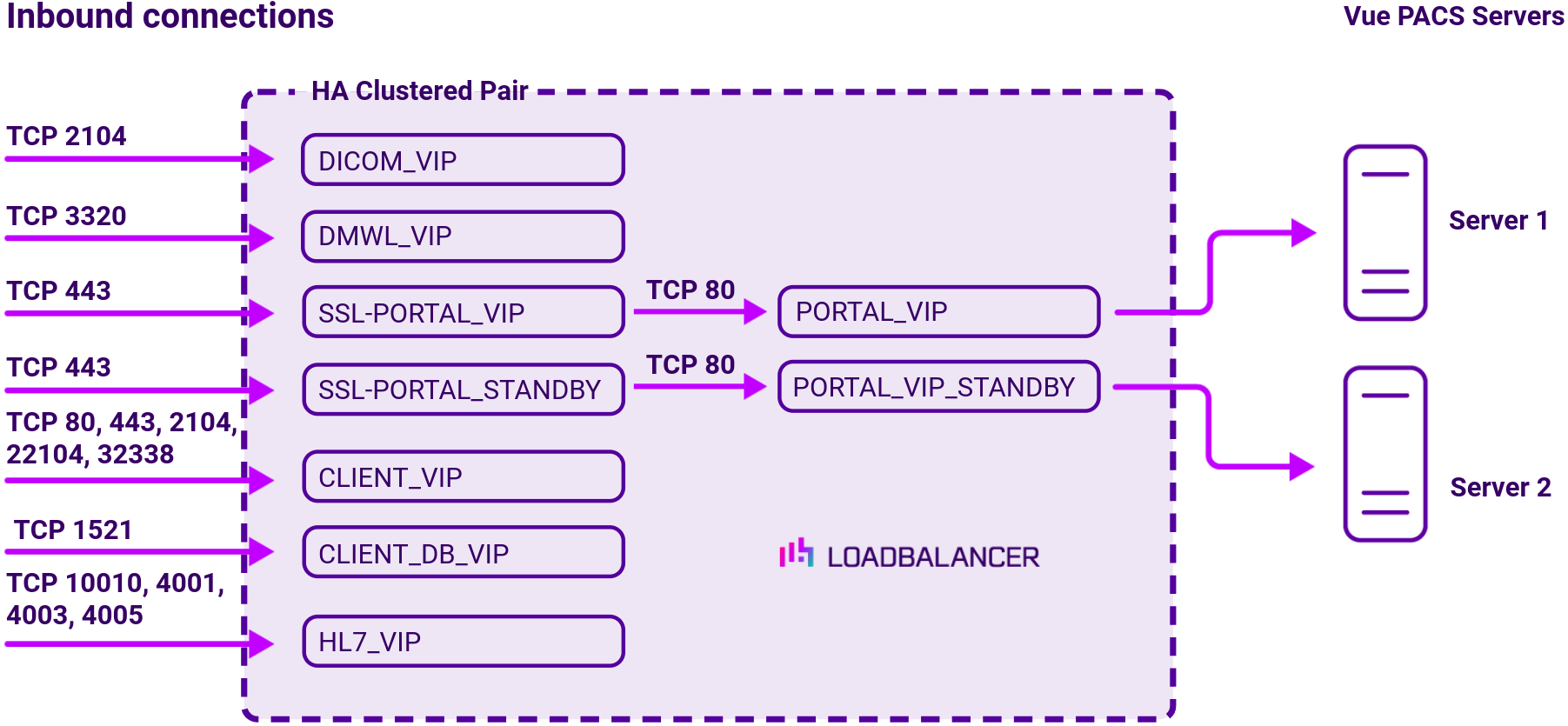
How to load balance Philips Vue PACS
Philips’ Vue PACS is an image-management platform that provides scalable local and wide area PACS solutions for hospitals and related institutions.
For full details of how to load balance this solution:
- Summary – A summary of the recommended deployment for Vue PACS.
- Deployment guide – The full Philips Vue PACS load balancer deployment guide.
Here’s a summary of the deployment concept: