









Load balancing Oracle WebLogic Server
Updated on February 3, 2026
•
Published on March 3, 2023
Benefits of load balancing Oracle WebLogic Server
Load balancing Oracle WebLogic Server offers the following benefits:
- High Availability (HA): Load balancing is crucial for achieving High Availability (HA), which ensures that your application remains accessible even if one or more components fail. The load balancer continuously monitors the health of all WebLogic Server instances in the cluster. If an instance fails, the load balancer automatically detects the failure and stops routing new requests to it. Traffic is then redirected to the remaining healthy servers. This automated failover process prevents a single server failure from causing an outage for end-users, significantly reducing downtime and enhancing service reliability.
- Scalability: Load balancing allows you to easily scale your WebLogic environment to handle increased user traffic without impacting service quality. By distributing incoming requests across multiple WebLogic instances, the load balancer prevents any single server from becoming overloaded, ensuring that the total available computing resources are utilized efficiently. When demand grows, you can simply add more WebLogic servers to your cluster. The load balancer instantly incorporates the new servers into its distribution pool, allowing you to scale horizontally and handle higher loads seamlessly.
- Improved application performance: By intelligently distributing the workload, load balancing directly contributes to better response times and a superior user experience. Load balancing algorithms (like Round Robin or Least Connections) ensure that requests are directed to the least busy or most capable server. This balanced utilization of resources prevents performance bottlenecks and improves overall throughput. Many load balancers can handle the CPU-intensive process of SSL/TLS encryption and decryption (SSL Offloading). By terminating the SSL connection at the load balancer, the WebLogic Server instances are relieved of this overhead, freeing up their processing power to focus on executing application logic, which improves application response time.
About Oracle WebLogic Server
Oracle WebLogic Server is an application server designed for developing and deploying and running enterprise applications, such as Java Enterprise Edition (EE) and Jakarta EE applications. While it can be used as a web server in its own right, it is better suited for hosting dynamic applications. This generally means it will sit behind another web server, e.g. OHS, Apache, Nginx, or IIS.
Why Loadbalancer.org for Oracle WebLogic Server?
Loadbalancer’s intuitive Enterprise Application Delivery Controller (ADC) is designed to save time and money with a clever, not complex, WebUI.
Easily configure, deploy, manage, and maintain our Enterprise load balancer, reducing complexity and the risk of human error. For a difference you can see in just minutes.
And with WAF and GSLB included straight out-of-the-box, there’s no hidden costs, so the prices you see on our website are fully transparent.
More on what’s possible with Loadbalancer.org.
How to load balance Oracle WebLogic Server
The load balancer can be deployed in 4 fundamental ways: Layer 4 DR mode, Layer 4 NAT mode, Layer 4 SNAT mode, and Layer 7 Reverse Proxy (Layer 7 SNAT mode).
For Oracle WebLogic Server, Layer 7 Reverse Proxy is recommended.
Virtual service (VIP) requirements
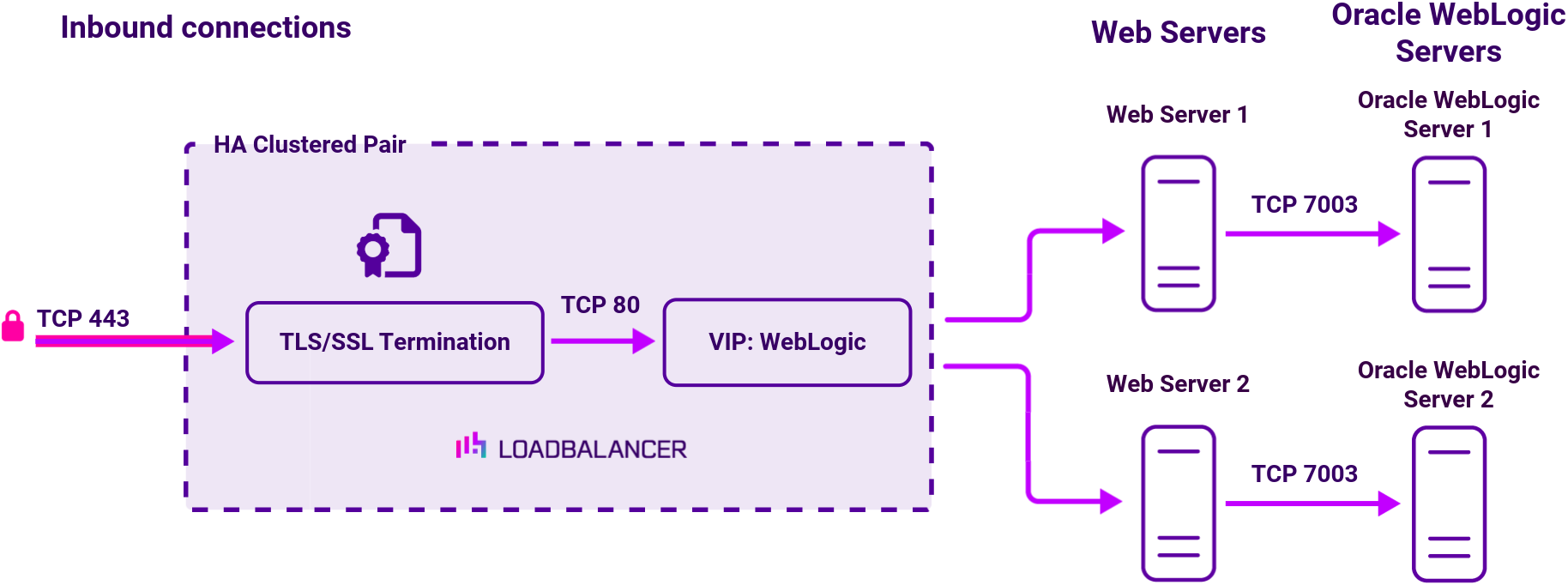
To provide load balancing and HA for Oracle WebLogic Server, a single VIP is required:
- HTTP
In addition, a TLS/SSL termination service is required to allow clients to connect using HTTPS.
Load balancing deployment concept
About Layer 7 Reverse Proxy load balancing
Layer 7 Reverse Proxy uses a proxy (HAProxy) at the application layer. Inbound requests are terminated on the load balancer and HAProxy generates a new corresponding request to the chosen Real Server. As a result, Layer 7 is typically not as fast as the Layer 4 methods.
Layer 7 is typically chosen when enhanced options such as SSL termination, cookie based persistence, URL rewriting, header insertion/deletion etc. are required, or when the network topology prohibits the use of the Layer 4 methods.
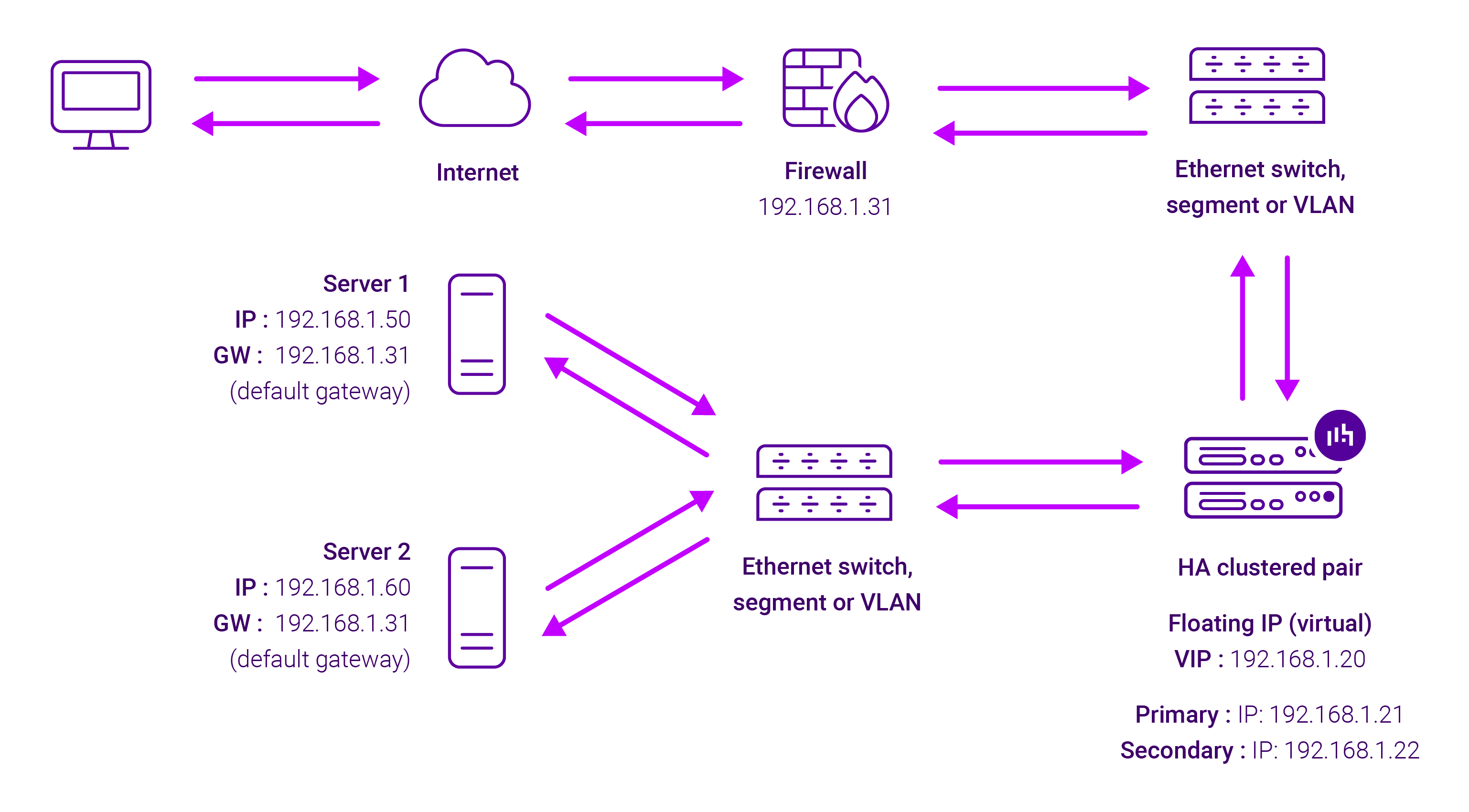
Because Layer 7 Reverse Proxy is a full proxy, any server in the cluster can be on any accessible subnet, including across the Internet or WAN.
Layer 7 Reverse Proxy is not transparent by default i.e. the Real Servers will not see the source IP address of the client, they will see the load balancer’s own IP address by default, or any other local appliance IP address if preferred (e.g. the VIP address). This can be configured per Layer 7 VIP.
If required, the load balancer can be configured to provide the actual client IP address to the Real Servers in two ways:
- Either by inserting a header that contains the client’s source IP address, or
- By modifying the Source Address field of the IP packets and replacing the IP address of the load balancer with the IP address of the client.
Layer 7 Reverse Proxy mode can be deployed using either a one-arm or two-arm configuration. For two-arm deployments, eth0 is normally used for the internal network and eth1 is used for the external network, although this is not mandatory.
No mode-specific configuration changes to the load balanced Real Servers are required.
Port translation is possible with Layer 7 Reverse Proxy e.g. VIP:80 → RIP:8080 is supported. You should not use the same RIP:PORT combination for Layer 7 Reverse Proxy VIPs and Layer 4 SNAT mode VIPs because the required firewall rules conflict.